

Last updated: October 2026
How can you find academic jobs in the Arab world? Combine four channels: the careers pages of universities you’ve shortlisted, specialist job boards such as Arab Academic Jobs, targeted web searches using local domains and academic rank titles, and professional networks. Treat each country separately because recruitment procedures, nationality conditions and degree-recognition rules differ. Read the required criteria in every advertisement before applying, and keep a record of every application.
Academic jobs in the Arab world are advertised through a patchwork of university portals, government recruitment systems, academic job boards and professional networks. No single source captures all of them.
The most effective approach is therefore not to search harder, but to search systematically: decide where you can realistically work, identify institutions that fit your discipline and career stage, monitor their recruitment channels, screen vacancies before spending time on applications, and keep the process running every week.
Is there one Arab academic job market?
No.
“Academic jobs in the Arab world” is a useful search category, but it covers university systems that can differ considerably in recruitment procedures, academic ranks, languages, qualification rules and eligibility requirements.
Current vacancies illustrate those differences.
American University of Sharjah, for example, uses institution-specific recruitment pages and online applications. One Assistant Professor position in Arabic Studies was posted in September 2026 with a November deadline for a Fall 2027 start.
Kuwait University operates its own online faculty recruitment system and explicitly states that candidates must meet all advertised requirements, while also warning that meeting those qualifications does not itself guarantee appointment.
In Jordan, universities including Yarmouk University, Amman Arab University and the University of Petra publish vacancies through their own institutional recruitment pages. Their advertisements can specify precise academic ranks, degree fields, publication conditions and application deadlines.
Morocco adds another route: public-sector academic competitions can appear through the national Emploi-Public system. A 2026 recruitment notice for an Enseignant-chercheur en Robotique at École Centrale Casablanca was published through that government portal, with a formal competition code and submission deadline.
The practical consequence is simple:
Build your search around countries, institution types and individual universities—not around “the Middle East” as if it were one labour market.
Where are academic jobs in the Arab world advertised?
1. University career websites
Official university recruitment pages should form the core of your search.
They are usually the best place to confirm:
- whether a vacancy is still open;
- the exact academic rank;
- mandatory and preferred qualifications;
- application documents;
- the submission method;
- the deadline;
- whether a position is open until filled.
Qatar University, for example, maintains a careers portal through which applicants can search opportunities across colleges, research centres and administrative departments.
KAUST maintains a dedicated faculty vacancies page covering faculty, researcher, postdoctoral and related appointments. As of October 2026, its listings included posts with fixed deadlines as well as positions marked open until filled, and several open-rank searches extended into 2027.
The American University in Cairo states that it publishes its staff and faculty vacancies on its website and maintains a separate faculty-vacancies section.
A practical method is to create a shortlist of around 20–40 realistic target universities.
For each one, record:
University | Country | Careers URL | Faculty page | Research page | Last checked | Alert available?
Then review the list on a fixed schedule rather than trying to rediscover universities every week.
2. Specialist academic job boards
Job boards solve a different problem: discovery across many institutions at once.
Arab Academic Jobs can be used to identify faculty, research and university professional-services vacancies across multiple Arab countries.
Browse academic vacancies on Arab Academic Jobs
International academic recruitment platforms can also identify positions in the region.
The right workflow is:
job board → discover vacancy → open the official university advertisement → verify requirements → apply through the specified channel
Do not assume that any academic job board contains every available position.
If a third-party listing and the university’s own page differ, use the university’s current advertisement as the authoritative source.
3. LinkedIn
LinkedIn is useful primarily for discovery and monitoring.
Follow:
- universities you’re targeting;
- university HR or talent-acquisition teams;
- individual faculties and colleges;
- research centres;
- department chairs;
- scholars working in your specialisation.
A LinkedIn post may tell you that recruitment has started. It does not normally replace the formal application.
That distinction matters: professional networks can help you discover an opportunity without bypassing the institution’s recruitment process.
4. Academic and professional networks
Academic societies, conferences, former collaborators and disciplinary communities can reveal opportunities that are harder to locate through broad searches.
They are particularly useful for:
- postdoctoral positions;
- research-project appointments;
- visiting faculty posts;
- grant-funded research roles;
- specialist faculty searches;
- new academic programmes.
Use networks to improve information flow—not as a substitute for meeting formal selection criteria.
5. Search engines
Generic searches such as “university jobs Middle East” generate a lot of noise.
Search engines become much more effective when you restrict them by academic title, domain and discipline.
Examples:
“assistant professor” site:edu.sa “mechanical engineering”
“faculty position” site:ac.ae
“faculty position” site:aus.edu
“assistant professor” site:edu.om
“faculty” site:edu.kw
“assistant professor” site:edu.eg
“faculty members” site:edu.jo
“open rank” professor Saudi Arabia university
“research scientist” university Qatar
For Morocco, add French terminology:
“maître de conférences” site:ac.ma
“enseignant chercheur” site:emploi-public.ma
There are two limitations.
First, not every university uses its country’s academic domain suffix. American University of Sharjah, for example, uses aus.edu.
Second, search engines may not index new advertisements immediately. For universities that matter to you, direct portal monitoring remains important.
Which Arab countries recruit academics?
There is no defensible ranking of Arab countries by academic opportunity from the data reviewed for this guide because no consistently collected, market-wide vacancy dataset was identified.
AAJ’s own data should therefore be used as a sample, not a census.
In a sample of 241 vacancies collected by Arab Academic Jobs up to 5 October 2026, the recorded locations were:
- UAE: 84
- Saudi Arabia: 55
- Oman: 30
- Bahrain: 29
- Kuwait: 18
- Qatar: 10
- Egypt: 10
- no structured country recorded: 5
Those numbers reflect what AAJ had collected at that point. They do not establish that the UAE has a larger academic labour market than Saudi Arabia or that countries with fewer advertisements have fewer academic opportunities.
What current institutional evidence does show is that recruitment channels differ substantially by country.
Saudi Arabia
Research-intensive institutions deserve separate monitoring.
KAUST explicitly encourages qualified Saudi and international candidates to apply and advertises faculty appointments across its academic divisions. Current listings include open-rank posts in areas such as water security and sustainable food security, as well as roles that remain open until filled.
Candidates should still read nationality requirements in each advertisement rather than assuming every Saudi university vacancy is internationally open.
United Arab Emirates
The UAE contains federal universities, private universities and internationally modelled institutions.
American University of Sharjah illustrates one model: its current Arabic Studies vacancy requires a relevant PhD and combines teaching and research expectations, while allowing applications many months before the planned start date.
Recruitment procedures can differ substantially between universities, so build institution-specific searches rather than relying only on “academic jobs UAE” queries.
Qatar
Qatar University operates a central careers portal covering academic programmes, research centres and professional departments.
Candidates should also search other institutions in Qatar separately, including specialist research organisations and Education City institutions.
Oman
University recruitment should be monitored directly, particularly at major institutions such as Sultan Qaboos University.
International applicants should also understand that formal employment procedures are country-specific. Oman’s official government guidance states that a work visa is issued at the employer’s request and under the employer’s responsibility, generally on the basis of a Ministry of Labour authorisation unless the employer is a government entity.
Kuwait
Kuwait University runs its own online faculty recruitment system.
Its recruitment page states:
- applicants should meet all requirements when applying; and
- meeting the stated qualifications does not guarantee appointment.
That is a useful reminder that eligibility and selection are different stages.
Bahrain
Check nationality requirements individually.
A University of Bahrain Lecturer vacancy for the 2026/27 academic year explicitly required applicants to be Bahraini citizens. That condition belongs to that particular advertisement and should not be generalised to every university position in Bahrain.
Egypt
Recruitment practices vary sharply by institution type.
The American University in Cairo operates its own faculty careers system and advertises positions across multiple disciplines. It also provides specific arrangements for expatriate faculty.
Egyptian public universities follow a different framework. Ain Shams University’s published appointment conditions, for example, state general faculty appointment requirements including a doctorate or recognised equivalent and Egyptian nationality.
Do not assume that the recruitment process at AUC represents Egyptian higher education as a whole.
Jordan
University websites are an important recruitment channel.
Yarmouk University’s recruitment system listed multiple Assistant Professor and lecturer vacancies in September 2026, while Amman Arab University published repeated faculty recruitment notices throughout the 2026 academic year.
The University of Petra’s September 2026 advertisement is particularly instructive: different posts carried different degree and publication requirements, and candidates with qualifications from outside Jordan were instructed to provide degree equivalency documentation.
Morocco
For public-sector academic recruitment, monitor the national Emploi-Public portal as well as individual institutions.
The portal publishes formal competition details, deadlines and submission routes.
French search terms can therefore be as important as English ones.
What types of academic jobs should you search for?
Searching only for “Assistant Professor” will miss relevant opportunities.
Useful terms include:
- Lecturer
- Senior Lecturer
- Instructor
- Assistant Professor
- Associate Professor
- Professor / Full Professor
- Open Rank
- Faculty Position
- Faculty Member
- Professor of Practice
- Research Fellow
- Research Associate
- Research Scientist
- Postdoctoral Fellow
Titles are not automatically equivalent between systems.
A Lecturer in one university system may occupy a different career stage from a Lecturer elsewhere. Likewise, “open rank” generally means that candidates may be considered at more than one professorial level, but the eventual appointment still depends on the advertisement and the candidate’s record.
AAJ’s own 241-vacancy sample illustrates the range. 188 posts were classified as academic or adjunct-academic, 36 as management/support roles and 10 as research roles, with seven remaining in other or uncategorised categories.
Academics considering professional-services careers should also search for:
- quality assurance;
- accreditation;
- academic development;
- e-learning;
- educational technology;
- institutional effectiveness;
- research administration;
- programme management;
- academic advising.
These can be especially relevant for experienced academics whose careers include university leadership or administration as well as teaching and research.
How to identify universities worth targeting
Do not build your target list from rankings alone.
For every institution, ask:
Does it employ academics in my discipline?
Check current departments, programmes and faculty profiles.
Does its institutional model fit my record?
A research-intensive university may value research trajectory, grants and doctoral supervision differently from a teaching-focused institution.
Does it recruit internationally?
Look at current vacancies and faculty composition rather than assuming.
What language is used for teaching?
Requirements can vary even between departments within the same university.
Are there accreditation or professional-registration expectations?
This may be especially relevant in engineering, health, architecture and business.
Does the advertised rank match my experience?
How does the university recruit?
Through a central HR portal? Departmental advertisements? A government system? Email? More than one of these?
This research is time-consuming the first time. Once a university is on your list, monitoring it becomes much faster.
How to read an academic vacancy before applying
Before spending hours preparing an application, divide the advertisement into three categories:
mandatory, preferred, and contextual.
Mandatory requirements
Look for phrases such as:
- required;
- must;
- minimum qualification;
- applicants must;
- eligibility requirement;
- only applicants meeting.
Then check each requirement against your profile.
Academic rank
Are you genuinely eligible for the advertised level?
Degree
Does the position require a PhD, or does it accept another terminal qualification?
Degree field
“PhD in Computer Science” is narrower than “PhD in Computer Science or a closely related field.”
Specialisation
Universities may recruit for a very specific subfield even when your broad discipline matches.
Experience
Distinguish between “minimum three years required” and “three years preferred.”
Research requirements
Look for:
- publication record;
- indexed publications;
- grant activity;
- research programme;
- graduate supervision;
- citation or impact expectations.
Treat Scopus or Web of Science as mandatory only when the advertisement says so.
In AAJ’s audited sample of 188 academic advertisements, a doctorate was mentioned in 170 (90.4%), publications in 133 (70.7%), Scopus in 38 (20.2%), and Web of Science in 9 (4.8%).
Those figures describe AAJ’s sample. They do not establish that Arab universities generally require Scopus publications, nor do they show whether every mention was mandatory.
Language
Do not assume Arabic is mandatory simply because the university is in an Arab country.
Read the advertisement.
Professional registration
Some engineering, architecture, health and professional programmes may require registration or licensing.
Nationality
Take nationality requirements literally.
The University of Bahrain example above shows why this matters.
Preferred requirements
Words such as:
- desirable;
- advantageous;
- preferred;
- priority will be given;
do not normally mean automatic exclusion.
If you meet the mandatory criteria and can perform the substantive duties, missing one preferred qualification should not automatically stop you applying.
The reverse also matters: a genuinely mandatory requirement shouldn’t be treated as optional simply because the rest of the vacancy looks attractive.
What documents should you prepare?
There is no universal application package.
Maintain a reusable folder containing:
- full academic CV;
- shorter CV if needed;
- cover-letter master;
- research statement;
- teaching statement or philosophy;
- publication list;
- selected publications;
- degree certificates;
- transcripts;
- referee details;
- teaching evaluations;
- professional licences or registrations;
- passport copy for later administrative stages.
Then follow the advertisement precisely.
The University of Petra’s September 2026 vacancies, for example, requested a CV, academic certificates and transcripts, identification, research evidence and—where degrees came from outside Jordan—degree-equivalency documentation.
The lesson is not that every Arab university wants those documents.
It is that one generic CV sent everywhere is not an application strategy.
What international applicants need to check
For an international candidate, meeting the academic criteria is only the first stage.
The second question is whether the appointment can be processed under the destination country’s documentation and employment rules.
Degree recognition and attestation
Saudi Arabia
Saudi Arabia’s Ministry of Education operates an official service for the equivalency of university qualifications issued outside the Kingdom.
The Ministry’s conditions cover matters including the awarding institution, programme recognition, previous qualifications, mode of study and document authentication. Specific provisions also address master’s and doctoral qualifications.
Faculty candidates should still ask the recruiting university whether formal equivalency is required for that appointment and at what stage.
UAE
The UAE Ministry of Higher Education and Scientific Research operates an official Recognition of Qualification from Outside the UAE service.
The service verifies international higher-education qualifications for professional, academic and employment purposes and requires verification of the qualification and accreditation of the awarding institution.
UAE qualification recognition service
Qatar
Qatar’s Ministry of Foreign Affairs provides an official academic-certificate attestation service.
Certificates issued outside Qatar must follow the required authentication route, and the Ministry also offers a service to complete attestation procedures for documents issued abroad.
Oman
Oman’s government portal provides an official service for the attestation and equivalency of qualifications issued by non-Omani higher-education institutions.
As of September 2026, the portal lists specific document, fee and verification requirements.
Do not begin an expensive attestation process simply because you saw an interesting vacancy. First confirm what the employer and destination authority require and when they require it.
Work authorisation
Procedures are not uniform across the GCC.
In Saudi Arabia, employers use the Qiwa system for work-visa services. The Ministry of Human Resources and Social Development describes permanent and temporary visa issuance through the platform.
In Oman, the official government service states that the employer requests the work visa and assumes responsibility for it, normally under a Ministry of Labour authorisation unless the employer is a government entity.
In Kuwait, the official private-sector work-entry visa process requires a work permit issued by the Public Authority for Manpower and sponsor documentation.
Before accepting an international appointment, ask:
- Who sponsors the visa?
- Which degrees must be recognised or attested?
- At what stage should attestation begin?
- Who pays document-verification costs?
- Is professional registration required?
- What is the contract duration?
- How does renewal work?
- Is relocation provided?
- Can dependants be sponsored?
- Is health insurance included?
- Is school support provided for children?
- What are the probation and notice periods?
For immigration and employment formalities, use current government information and the university’s HR office—not an old forum discussion.
When should you search for academic vacancies?
There is no evidence for one universal Arab academic recruitment season.
AAJ’s 241-vacancy dataset should not be used to infer one because its collection intensity has not been demonstrated to be consistent throughout the year.
Current vacancies show a wide range of lead times.
AUS posted an Assistant Professor vacancy in September 2026 with a deadline in November 2026 for a Fall 2027 start.
KAUST simultaneously had positions closing in October 2026, posts with deadlines in June 2027 and others listed as open until filled.
Jordan provides the opposite example: some current university advertisements use much shorter application windows. Ajloun National University, for example, published multiple 2026 recruitment notices with windows ranging from around one week to two weeks.
The practical rule is therefore:
Search throughout the year.
Pay particular attention to appointments advertised months ahead of an August/September or January start, but don’t assume vacancies outside those periods are unusual.
A practical weekly academic job-search system
A repeatable process is more effective than occasional intensive searching.
Step 1 — Define your boundary
Write down:
- target countries;
- discipline and sub-specialisation;
- acceptable ranks;
- research versus teaching preference;
- institution types;
- languages;
- citizenship constraints;
- work-authorisation constraints;
- relocation constraints.
Step 2 — Build a target list
Select around 20–40 universities.
Classify them:
Priority A — strong fit
Priority B — plausible fit
Priority C — monitor occasionally
Store the official careers URL for each.
Step 3 — Check academic job boards
Scan Arab Academic Jobs and relevant international academic recruitment platforms.
Save potentially suitable vacancies.
Step 4 — Check university portals directly
Do this even if the university hasn’t appeared on your job boards that week.
Step 5 — Run targeted search queries
Change titles, disciplines, countries and domains.
Don’t run exactly the same broad search every week.
Step 6 — Screen before applying
Ask:
Mandatory criteria met?
Specialisation credible?
Rank appropriate?
Research profile sufficient?
Teaching profile sufficient?
Language requirement met?
Nationality restriction?
Professional registration required?
Deadline realistic?
Then classify the vacancy:
Apply | Maybe | Skip
Step 7 — Tailor your application
Use the employer’s terminology.
If the advertisement asks for experience teaching specific subjects, show evidence for those subjects.
If it asks for an independent research programme, address that explicitly rather than submitting a generic research biography.
Step 8 — Record every application
Track:
University | Position | Country | Source | Date found | Deadline | Date applied | Documents | Status | Contact | Follow-up
Step 9 — Review weekly
Update:
- newly advertised positions;
- approaching deadlines;
- applications submitted;
- vacancies moved from “Maybe” to “Apply”;
- universities whose recruitment patterns are becoming clearer.
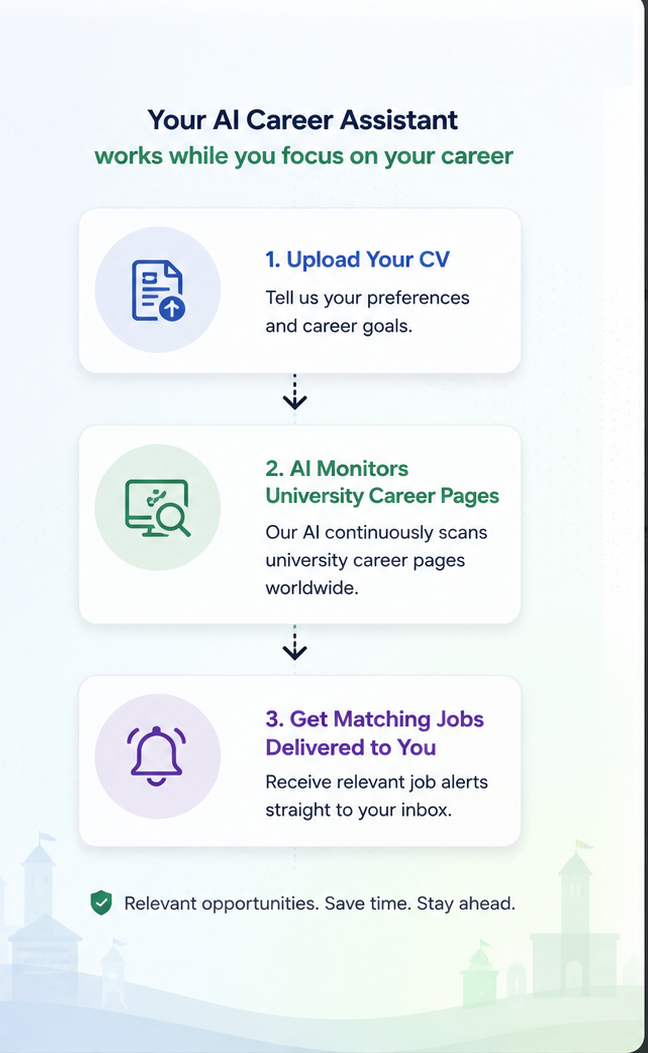
Arab Academic Jobs fits into this system as one discovery source alongside direct university pages, targeted searches and professional networks.
Common mistakes when searching for academic jobs
Treating the region as one market
Recruitment in a UAE private university can look very different from public-sector appointment procedures elsewhere.
Depending on one job board
No single board should be assumed to capture every vacancy.
Searching only for Assistant Professor
You may miss Lecturer, open-rank, research, postdoctoral and professional university roles.
Treating preferred requirements as mandatory
Read the language carefully.
Ignoring mandatory requirements
A required degree, nationality, specialisation, licence or language condition deserves serious weight.
Ignoring nationality restrictions
These sometimes appear in the individual advertisement rather than on a university’s general careers page.
Assuming Arabic is always required
Check the individual vacancy.
Sending the same CV everywhere
Application documents and evaluation criteria differ.
Starting attestation without checking
Recognition and attestation can cost money and take time. Confirm what is actually required first.
Searching only in English
Arabic and French searches can uncover additional vacancies in parts of the region.
Not tracking applications
Without a tracker, deadlines and follow-ups become difficult to manage.
Frequently asked questions
Where can I find academic jobs in the Middle East?
Use official university careers pages, specialist academic job boards such as Arab Academic Jobs, targeted search-engine queries, LinkedIn and academic networks. Government recruitment portals also matter in some systems, including Morocco’s Emploi-Public platform.
Which Gulf countries hire international professors?
International academic recruitment is visible in countries including Saudi Arabia, the UAE, Qatar and Oman, but eligibility must be checked vacancy by vacancy. KAUST, for example, explicitly encourages qualified international as well as Saudi candidates to apply.
Do I need Arabic to work at an Arab university?
Not necessarily. Language requirements depend on the institution, department and role. Use the individual advertisement as the authority rather than assuming that Arabic is mandatory—or that English will always be sufficient.
Do Gulf universities require a PhD?
Many professorial vacancies do, but requirements vary by rank and institution. In AAJ’s audited sample of 188 academic advertisements, 170 mentioned a doctorate. That figure describes AAJ’s sample; it is not a rule for every Arab university.
When should I apply for academic jobs in Saudi Arabia or the UAE?
Search year-round. Current evidence does not establish one universal recruitment month. Some appointments are advertised close to a year before the expected start date, while others remain open until filled.
Can I apply directly through university websites?
Yes, when the advertisement instructs you to. Qatar University, Kuwait University, AUC and many other institutions maintain direct recruitment systems.
What documents do faculty applications normally require?
Requirements vary. Common documents include an academic CV, cover letter, degree certificates, research and teaching statements, publication evidence and referee information. Always use the specific vacancy as your checklist.
Final checklist
Before applying, confirm that you have:
- defined your target countries and ranks;
- checked the official advertisement;
- confirmed that the vacancy is still open;
- met the mandatory degree requirement;
- checked field and specialisation requirements;
- evaluated the rank realistically;
- checked research expectations;
- checked teaching expectations;
- checked language requirements;
- checked nationality conditions;
- checked professional-registration requirements;
- confirmed the application method;
- prepared all required documents;
- recorded the deadline and time zone;
- checked degree-recognition requirements where relevant;
- added the application to your tracker.
Conclusion
Finding academic jobs in the Arab world is not a matter of discovering one perfect jobs website.
The more reliable strategy is to build a repeatable search system.
Use specialist platforms such as Arab Academic Jobs for discovery. Maintain a shortlist of target universities and check their official careers pages directly. Use targeted search queries, LinkedIn and professional networks to widen your coverage. Then screen every vacancy against its mandatory requirements before investing time in the application.
Most importantly, treat Saudi Arabia, the UAE, Qatar, Oman, Kuwait, Bahrain, Egypt, Jordan, Morocco and other Arab countries as distinct recruitment environments.
That approach produces fewer irrelevant applications—and gives you a much better chance of noticing the opportunities that actually fit your academic profile.
Browse current academic and university vacancies across the Arab world on Arab Academic Jobs.
Sources and further reading
University recruitment
American University in Cairo Careers
American University of Sharjah — Arabic Studies Faculty Position
Kuwait University Open Faculty Positions
University of Bahrain Recruitment
University of Petra — September 2026 Faculty Vacancies
Yarmouk University Recruitment Portal
Amman Arab University Job Announcements
Morocco Emploi-Public Academic Recruitment Example
Qualification recognition and international documentation
Saudi Ministry of Education — Equivalency of Qualifications Issued Outside Saudi Arabia
UAE Ministry of Higher Education — Recognition of Qualifications from Outside the UAE
Qatar Ministry of Foreign Affairs — Academic Certificate Attestation
Oman Government — Attestation and Equivalency of Academic Qualifications
Work authorisation
Saudi Ministry of Human Resources — Work Visa Services via Qiwa